Trigonometry, the study of relationships between angles and sides of triangles, is a cornerstone of mathematics, physics, and engineering. Mastering trigonometric identities is crucial for simplifying complex equations, solving problems, and gaining a deeper understanding of these fields. This comprehensive cheat sheet provides a quick and easy reference to all the essential trig identities, empowering you to tackle any trigonometric challenge with confidence.
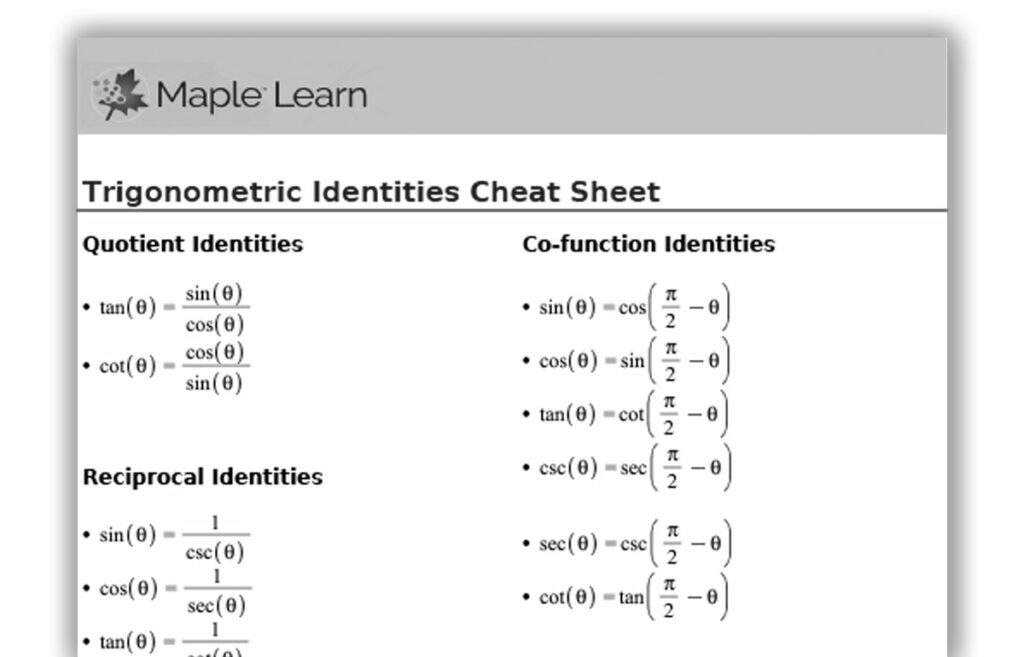
This guide covers fundamental identities, reciprocal identities, quotient identities, Pythagorean identities, sum and difference formulas, double-angle formulas, half-angle formulas, power-reducing formulas, product-to-sum formulas, and sum-to-product formulas. Each identity is presented clearly and concisely, along with examples to illustrate their application. Whether you’re a student struggling with homework or a professional needing a quick refresher, this cheat sheet will be your go-to resource for all things trig.
What are Trigonometric Identities?
Trigonometric identities are equations that are true for all values of the variables for which both sides of the equation are defined. These identities are used to simplify trigonometric expressions and solve trigonometric equations. They provide a fundamental toolkit for manipulating and understanding trigonometric functions.
Why are Trigonometric Identities Important?
- Simplification: They allow us to simplify complex trigonometric expressions into more manageable forms.
- Problem Solving: They are crucial for solving trigonometric equations and problems in various fields.
- Calculus: They are used extensively in calculus for integration and differentiation of trigonometric functions.
- Physics and Engineering: They are fundamental in physics and engineering for analyzing waves, oscillations, and other periodic phenomena.
Fundamental Trigonometric Identities
These are the most basic identities, forming the foundation for all other identities.
Reciprocal Identities
- csc(θ) = 1/sin(θ)
- sec(θ) = 1/cos(θ)
- cot(θ) = 1/tan(θ)
Example: If sin(θ) = 0.5, then csc(θ) = 1/0.5 = 2.
Quotient Identities
- tan(θ) = sin(θ)/cos(θ)
- cot(θ) = cos(θ)/sin(θ)
Example: If sin(θ) = 0.6 and cos(θ) = 0.8, then tan(θ) = 0.6/0.8 = 0.75.
Pythagorean Identities
- sin2(θ) + cos2(θ) = 1
- 1 + tan2(θ) = sec2(θ)
- 1 + cot2(θ) = csc2(θ)
Example: If sin(θ) = 0.6, then cos2(θ) = 1 – sin2(θ) = 1 – 0.36 = 0.64, so cos(θ) = 0.8.
Angle Sum and Difference Identities
These identities express trigonometric functions of sums and differences of angles.
Sum Identities
- sin(α + β) = sin(α)cos(β) + cos(α)sin(β)
- cos(α + β) = cos(α)cos(β) – sin(α)sin(β)
- tan(α + β) = (tan(α) + tan(β)) / (1 – tan(α)tan(β))
Difference Identities
- sin(α – β) = sin(α)cos(β) – cos(α)sin(β)
- cos(α – β) = cos(α)cos(β) + sin(α)sin(β)
- tan(α – β) = (tan(α) – tan(β)) / (1 + tan(α)tan(β))
Example: To find sin(75°), use sin(45° + 30°) = sin(45°)cos(30°) + cos(45°)sin(30°) = (√2/2)(√3/2) + (√2/2)(1/2) = (√6 + √2)/4.
Double-Angle Identities
These identities express trigonometric functions of double angles.
- sin(2θ) = 2sin(θ)cos(θ)
- cos(2θ) = cos2(θ) – sin2(θ) = 2cos2(θ) – 1 = 1 – 2sin2(θ)
- tan(2θ) = 2tan(θ) / (1 – tan2(θ))
Example: If sin(θ) = 0.6 and cos(θ) = 0.8, then sin(2θ) = 2(0.6)(0.8) = 0.96.
Half-Angle Identities
These identities express trigonometric functions of half angles.
- sin(θ/2) = ±√((1 – cos(θ))/2)
- cos(θ/2) = ±√((1 + cos(θ))/2)
- tan(θ/2) = ±√((1 – cos(θ))/(1 + cos(θ))) = sin(θ) / (1 + cos(θ)) = (1 – cos(θ)) / sin(θ)
Example: To find sin(15°), use sin(30°/2) = √((1 – cos(30°))/2) = √((1 – √3/2)/2).
Power-Reducing Identities
These identities rewrite powers of trigonometric functions in terms of functions with multiple angles.
- sin2(θ) = (1 – cos(2θ))/2
- cos2(θ) = (1 + cos(2θ))/2
- tan2(θ) = (1 – cos(2θ)) / (1 + cos(2θ))
Example: To rewrite sin2(x), use sin2(x) = (1 – cos(2x))/2.
Product-to-Sum Identities
These identities express products of trigonometric functions as sums or differences.
- sin(α)cos(β) = (1/2)
- cos(α)sin(β) = (1/2)
- cos(α)cos(β) = (1/2)
- sin(α)sin(β) = (1/2)
Example: To rewrite sin(2x)cos(3x), use sin(2x)cos(3x) = (1/2) = (1/2).
Sum-to-Product Identities
These identities express sums or differences of trigonometric functions as products.
- sin(α) + sin(β) = 2sin((α + β)/2)cos((α – β)/2)
- sin(α) – sin(β) = 2cos((α + β)/2)sin((α – β)/2)
- cos(α) + cos(β) = 2cos((α + β)/2)cos((α – β)/2)
- cos(α) – cos(β) = -2sin((α + β)/2)sin((α – β)/2)
Example: To rewrite sin(5x) + sin(x), use sin(5x) + sin(x) = 2sin(3x)cos(2x).
Common Questions About Trigonometric Identities
- How do I memorize trigonometric identities? Practice is key! Use flashcards, solve problems, and try to derive the identities yourself. Understanding the derivations can help you remember them better.
- What is the most important trigonometric identity? The Pythagorean identity (sin2(θ) + cos2(θ) = 1) is arguably the most important, as it is the foundation for many other identities.
- Where can I use trigonometric identities in real life? Trigonometric identities are used in various fields, including physics (wave mechanics), engineering (signal processing), and computer graphics (3D modeling).
- Are there any tricks for simplifying trigonometric expressions? Look for opportunities to use Pythagorean identities, reciprocal identities, and quotient identities. Also, try to express everything in terms of sine and cosine.
Conclusion
This cheat sheet provides a comprehensive overview of essential trigonometric identities. By mastering these identities, you’ll be well-equipped to tackle a wide range of trigonometric problems. Remember to practice regularly and apply these identities in different contexts to solidify your understanding. Keep this guide handy as a quick reference whenever you need a refresher. Happy calculating!
Understanding and applying trigonometric identities is not just about memorization; it’s about developing a deeper understanding of the relationships between angles and sides in triangles, and how these relationships can be used to model and solve problems in the real world. So, dive in, explore, and unlock the power of trigonometric identities!
