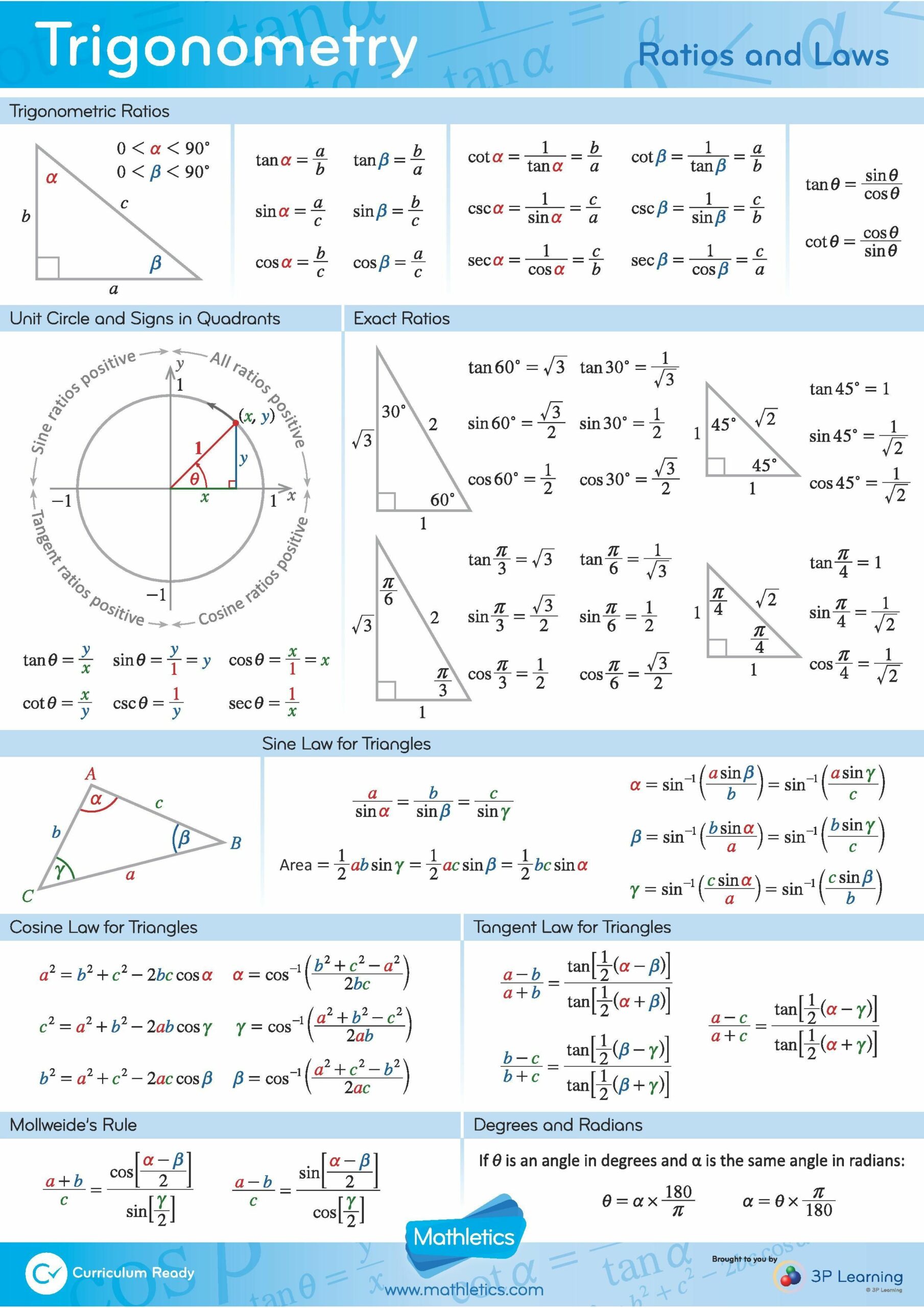
Trigonometry, the study of relationships between angles and sides of triangles, is a cornerstone of mathematics and physics. Mastering trigonometric identities is crucial for success in these fields. This comprehensive guide provides a trig identities cheat sheet, explanations, and practical applications to help you conquer trigonometry.
What are Trigonometric Identities?
Trigonometric identities are equations involving trigonometric functions that are true for all values of the variables for which the functions are defined. These identities are essential tools for simplifying trigonometric expressions, solving equations, and understanding various mathematical concepts.
Why Use a Trig Identities Cheat Sheet?
A trig identities cheat sheet is a quick reference guide that compiles the most important trigonometric identities in one place. It saves time and effort by providing a readily available resource for solving problems and understanding trigonometric relationships. Whether you’re a student, teacher, or professional, a cheat sheet can be an invaluable tool.
Fundamental Trigonometric Identities
These identities form the foundation of trigonometry and are essential for understanding more complex concepts.
Reciprocal Identities
Reciprocal identities define the relationships between the six trigonometric functions.
- sin(θ) = 1 / csc(θ)
- cos(θ) = 1 / sec(θ)
- tan(θ) = 1 / cot(θ)
- csc(θ) = 1 / sin(θ)
- sec(θ) = 1 / cos(θ)
- cot(θ) = 1 / tan(θ)
Quotient Identities
Quotient identities express tangent and cotangent in terms of sine and cosine.
- tan(θ) = sin(θ) / cos(θ)
- cot(θ) = cos(θ) / sin(θ)
Pythagorean Identities
Pythagorean identities are derived from the Pythagorean theorem and are fundamental to trigonometry.
- sin2(θ) + cos2(θ) = 1
- 1 + tan2(θ) = sec2(θ)
- 1 + cot2(θ) = csc2(θ)
Even and Odd Identities
Even and odd identities describe the symmetry of trigonometric functions.
- sin(-θ) = -sin(θ)
- cos(-θ) = cos(θ)
- tan(-θ) = -tan(θ)
- csc(-θ) = -csc(θ)
- sec(-θ) = sec(θ)
- cot(-θ) = -cot(θ)
Sum and Difference Formulas
These formulas express trigonometric functions of sums and differences of angles.
Sine Sum and Difference
- sin(A + B) = sin(A)cos(B) + cos(A)sin(B)
- sin(A – B) = sin(A)cos(B) – cos(A)sin(B)
Cosine Sum and Difference
- cos(A + B) = cos(A)cos(B) – sin(A)sin(B)
- cos(A – B) = cos(A)cos(B) + sin(A)sin(B)
Tangent Sum and Difference
- tan(A + B) = (tan(A) + tan(B)) / (1 – tan(A)tan(B))
- tan(A – B) = (tan(A) – tan(B)) / (1 + tan(A)tan(B))
Double-Angle Formulas
Double-angle formulas express trigonometric functions of twice an angle.
Sine Double-Angle
sin(2θ) = 2sin(θ)cos(θ)
Cosine Double-Angle
- cos(2θ) = cos2(θ) – sin2(θ)
- cos(2θ) = 2cos2(θ) – 1
- cos(2θ) = 1 – 2sin2(θ)
Tangent Double-Angle
tan(2θ) = (2tan(θ)) / (1 – tan2(θ))
Half-Angle Formulas
Half-angle formulas express trigonometric functions of half an angle.
Sine Half-Angle
sin(θ/2) = ±√((1 – cos(θ)) / 2)
Cosine Half-Angle
cos(θ/2) = ±√((1 + cos(θ)) / 2)
Tangent Half-Angle
- tan(θ/2) = ±√((1 – cos(θ)) / (1 + cos(θ)))
- tan(θ/2) = sin(θ) / (1 + cos(θ))
- tan(θ/2) = (1 – cos(θ)) / sin(θ)
Product-to-Sum Formulas
These formulas express products of trigonometric functions as sums or differences.
- sin(A)cos(B) = 1/2
- cos(A)sin(B) = 1/2
- cos(A)cos(B) = 1/2
- sin(A)sin(B) = 1/2
Sum-to-Product Formulas
These formulas express sums or differences of trigonometric functions as products.
- sin(A) + sin(B) = 2sin((A + B) / 2)cos((A – B) / 2)
- sin(A) – sin(B) = 2cos((A + B) / 2)sin((A – B) / 2)
- cos(A) + cos(B) = 2cos((A + B) / 2)cos((A – B) / 2)
- cos(A) – cos(B) = -2sin((A + B) / 2)sin((A – B) / 2)
Common Questions About Trig Identities
How do I memorize trigonometric identities?
- Understand the Derivations: Understanding how identities are derived from fundamental principles like the Pythagorean theorem can make them easier to remember.
- Use Flashcards: Flashcards are a great way to drill yourself on the identities and their formulas.
- Practice Regularly: The more you use the identities in problem-solving, the better you’ll remember them.
- Create Mnemonics: Develop memory aids or acronyms to help recall specific identities.
What is the most important trigonometric identity?
The most fundamental and widely used trigonometric identity is the Pythagorean identity: sin2(θ) + cos2(θ) = 1. This identity is the basis for many other trigonometric relationships and is essential for solving a wide range of problems.
How are trigonometric identities used in real life?
- Engineering: Used in structural analysis, signal processing, and control systems.
- Physics: Applied in mechanics, optics, and electromagnetism.
- Navigation: Essential for calculating distances and angles in aviation and maritime navigation.
- Computer Graphics: Used in creating realistic 3D models and animations.
- Astronomy: Applied in calculating distances and positions of celestial objects.
How do you prove trigonometric identities?
- Start with the More Complex Side: Begin with the side of the equation that appears more complicated and try to simplify it.
- Use Known Identities: Apply fundamental identities, such as Pythagorean, reciprocal, and quotient identities, to rewrite expressions.
- Convert to Sine and Cosine: If other trigonometric functions are involved, convert them to sine and cosine to simplify the expression.
- Algebraic Manipulation: Use algebraic techniques like factoring, expanding, and simplifying fractions to manipulate the expression.
- Work Towards the Other Side: Keep the other side of the equation in mind and work towards transforming the complex side into the simpler side.
Tips for Using Trig Identities Effectively
- Know Your Identities: Familiarize yourself with the basic identities and their variations.
- Practice Regularly: Consistent practice is key to mastering trigonometric identities.
- Break Down Complex Problems: Simplify complex problems by breaking them down into smaller, manageable steps.
- Check Your Work: Always verify your solutions to ensure accuracy.
- Use a Cheat Sheet: Keep a trig identities cheat sheet handy for quick reference.
Conclusion
Mastering trigonometric identities is essential for success in mathematics, physics, and engineering. This comprehensive guide and trig identities cheat sheet provide the tools and knowledge you need to excel in trigonometry. By understanding the fundamental identities, practicing regularly, and applying these concepts to real-world problems, you can unlock the power of trigonometry and achieve your academic and professional goals. Keep this cheat sheet as a handy reference, and continue to explore the fascinating world of trigonometry!
By using this trig identities cheat sheet, you’ll be well-equipped to tackle any trigonometry problem that comes your way. Good luck!
