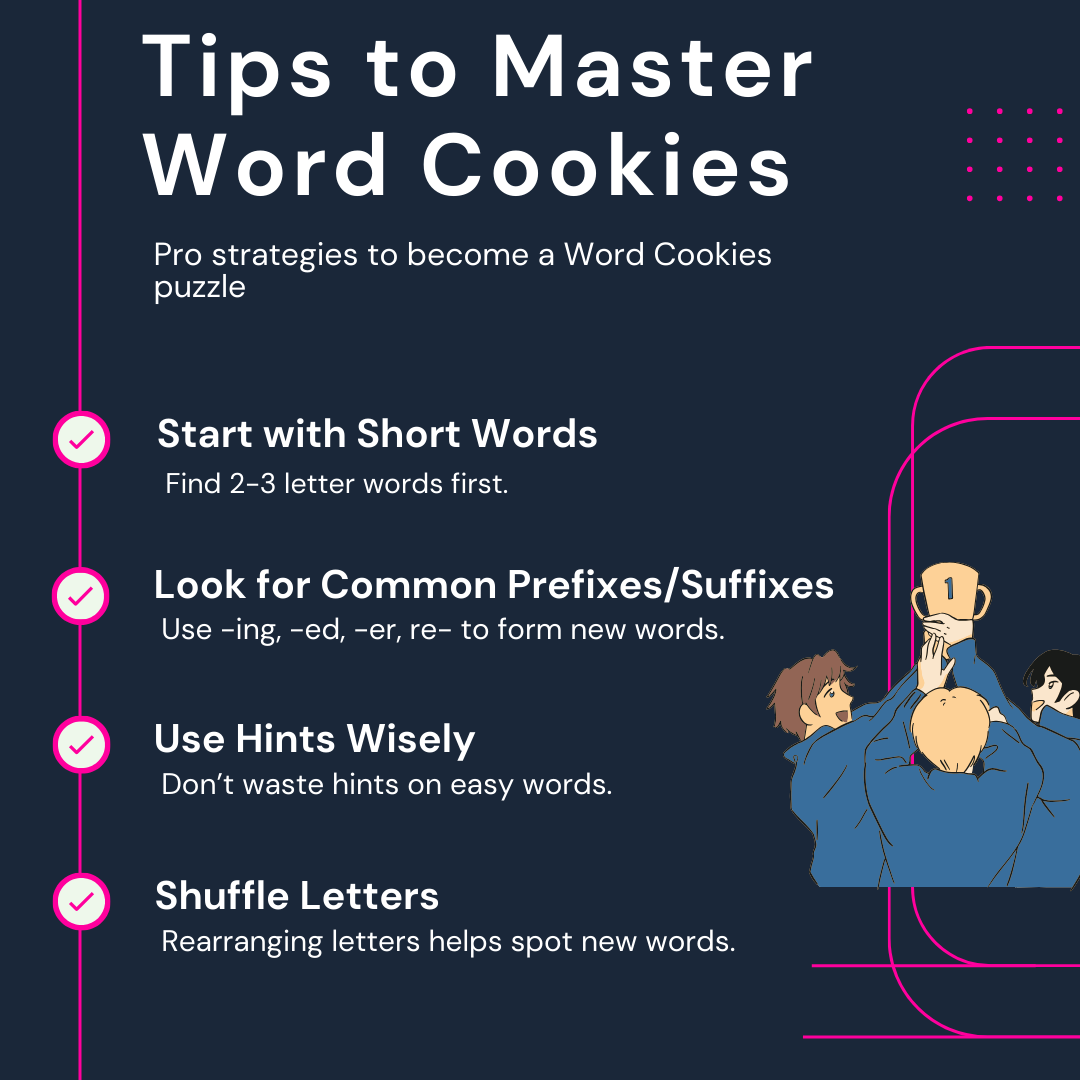
Word Cookies is a captivating word puzzle game that challenges your vocabulary and problem-solving skills. However, sometimes those letter combinations can be incredibly tricky. This guide serves as your ultimate cheat sheet, providing strategies and resources to help you solve every puzzle and beat every level of Word Cookies. Whether you’re a beginner or a seasoned player, this guide will equip you with the tools you need to succeed.
This guide is important because it provides a structured approach to solving Word Cookies puzzles. Instead of relying solely on luck, you’ll learn techniques to systematically uncover hidden words. It solves the frustration of being stuck on a level, allowing you to progress through the game and enjoy the challenge without feeling defeated.
- Word Cookies Game: Downloaded and installed on your device.
- Internet Access: For using online word solvers and dictionaries.
- Pencil and Paper (Optional): For brainstorming and jotting down possibilities.
- Word Solver Websites/Apps: Examples include WordFinder, UnscrambleX, and WordTips.
- Dictionary/Thesaurus: For verifying word validity and exploring synonyms.
1. Analyze the Letters: Begin by carefully examining the letters provided in the puzzle. Note the frequency of each letter, as more common letters like ‘E’, ‘A’, and ‘S’ are likely to appear in multiple words.
2. Identify Common Prefixes and Suffixes: Look for common prefixes (e.g., ‘un-‘, ‘re-‘, ‘pre-‘) and suffixes (e.g., ‘-ing’, ‘-ed’, ‘-tion’). These can provide valuable clues about potential words.
3. Start with Shorter Words: Focus on finding shorter words (3-4 letters) first. These are often easier to spot and can help you identify the remaining letters in the puzzle.
4. Use a Word Solver: When you’re stuck, utilize a word solver website or app. Enter the letters from the puzzle, and the solver will generate a list of possible words. Popular options include WordFinder, UnscrambleX, and WordTips.
5. Prioritize Longer Words: Once you’ve found the shorter words, shift your focus to identifying longer words. These often contribute more points and can unlock bonus words.
6. Look for Common Word Patterns: Be aware of common word patterns, such as CVC (consonant-vowel-consonant) or VCCV (vowel-consonant-consonant-vowel). This can help you anticipate potential word structures.
7. Consider Word Families: Think about word families, which are groups of words with a common root. For example, if you find the word ‘act’, consider words like ‘acting’, ‘action’, and ‘actor’.
8. Check for Plurals and Verb Conjugations: Don’t forget to check for plural forms (adding ‘-s’ or ‘-es’) and verb conjugations (e.g., ‘-ed’, ‘-ing’). These are often overlooked but can be easy solutions.
9. Use a Dictionary/Thesaurus: If you’re unsure whether a word is valid, consult a dictionary or thesaurus. This will help you confirm the spelling and meaning of the word.
10. Brainstorm and Jot Down Possibilities: Sometimes, the best approach is to simply brainstorm and jot down any words that come to mind. Even if a word doesn’t seem immediately obvious, it might spark a connection to another word.
11. Try Different Letter Combinations: Experiment with different letter combinations. Sometimes, rearranging the letters in a different order can reveal hidden words.
12. Look for Anagrams: Anagrams are words that are formed by rearranging the letters of another word. For example, ‘team’ is an anagram of ‘meat’.
13. Identify Vowels: Ensure that every word you form contains at least one vowel. Words without vowels are not valid in Word Cookies.
14. Pay Attention to Theme: Some Word Cookies levels have a specific theme. Keeping the theme in mind can help you narrow down the possible words.
15. Clear Your Mind and Start Fresh: If you’ve been working on a puzzle for a while and are still stuck, take a break and clear your mind. Sometimes, a fresh perspective is all you need to find the solution.
16. Don’t Overlook Obvious Words: Sometimes, the most obvious words are the ones we overlook. Make sure you’ve considered all the simple and common words.
17. Use Hints Sparingly: Word Cookies offers hints, but use them sparingly. They can be helpful in a pinch, but relying on them too much will hinder your problem-solving skills.
18. Practice Regularly: The more you play Word Cookies, the better you’ll become at recognizing word patterns and identifying potential words.
19. Collaborate with Others: If you’re really stuck, consider collaborating with friends or family members. A fresh set of eyes might be able to spot something you’ve missed.
20. Celebrate Your Successes: When you solve a puzzle, take a moment to celebrate your success. This will help you stay motivated and engaged with the game.
- Incorrect Spelling: Double-check the spelling of every word before submitting it. Even a minor typo can prevent you from solving the puzzle.
- Ignoring Common Letters: Pay close attention to the most common letters in the puzzle, such as ‘E’, ‘A’, and ‘S’. These letters are likely to appear in multiple words.
- Overlooking Plurals and Verb Forms: Don’t forget to check for plural forms (adding ‘-s’ or ‘-es’) and verb conjugations (e.g., ‘-ed’, ‘-ing’).
- Relying Too Much on Word Solvers: While word solvers can be helpful, relying on them too much will prevent you from developing your own problem-solving skills.
- Giving Up Too Easily: Don’t give up if you’re stuck on a puzzle. Take a break, clear your mind, and try again.
By following these steps and utilizing the resources provided, you’ll be well-equipped to solve every puzzle and beat every level of Word Cookies. Remember to be patient, persistent, and creative. With practice, you’ll become a Word Cookies master in no time! So, go ahead, put these tips to the test, and enjoy the satisfaction of conquering every challenge that Word Cookies throws your way.